Search This Blog

Showing posts with label religion. Show all posts

Wednesday, January 11, 2017

Nobody Expects the Science Inquisition


This episode of James Burke's "The Day the Universe Changed" is particularly fascinating and well worth watching. Science snobs always hate this bit. Burke's description of the structure of scientific progress is straight out of Thomas Kuhn's seminal work "The Structure of Scientific Revolution" and Burke is dead on. It upsets those who adhere to the modern cult of sciencism to think that their religion would actually hang on to bad ideas and false theories, but it does. I mean how many college professors are comfortable standing up in front of their classes and telling them to pitch out the $200 book (written by the professor) that they all were forced to buy for his class last year is all wrong. What Ph.D, wants to tell his grad students that some basic concept he forced them to memorize last year wasn't true at all this year? That's why science advances in plateaus and then big jumps. It's a lot of trouble to change out the textbooks.

I love Burke's idea that computer technology could make elitist centralized governments obsolete. The spectre of a human-utopia yields in this fantasy to a machine-utopia. Both optimistically assume that humans or machines can make things perfect, without the pesky need for God or for his work on changing the human heart. This episode dates back 3 decades or more from the beginning of the personal computer revolution before the Internet rose to it's current power. Burke had little idea just how much the existence of a machine-based free market of ideas would rattle the great halls of human power, whether for good or evil.

Of course politicians hold politics in the same reverence that scientists and science fans hold science and with the same naivete. A person's belief system greatly influences how he sees the world and what he believes to be true can lead him to do some pretty appalling things. Burke was right. If you are not comfortable with what he said in the episode about science, then you probably aren't a scientist, but a person who treats science as a religion. I expressed this, as I thought, reasonable opinion in the comment section of the video and immediately got romped on and called "vapid" an "idiot" and a "troll"

One expects this sort of reaction from science true believers when you challenge their religious devotion to the idea of the purity of science. Thomas Kuhn ruffled plenty of science fan feathers half a century ago, when, in his book, he pointed out the Achilles heel of science - the human factor. This factor tends to be ignored by science fanboys with the same intensity that Catholics ignore pedophilia amongst the priesthood. Anything that violates your religious belief (and make no mistake about it, sciencism is a religion) is rejected with disdain. Science personality Neil deGrasse Tyson does this sort of thing a lot. His predecessor Carl Sagan at least left a little room for things science doesn't know - in my opinion making him a more honest practitioner of science than deGrasse.

If you've ever hung around scientists and are at all free from the grip of overwhelming science adoration, you will be disturbed to find that scientists can be as prissy, self-centered a gang of egotists as the college of cardinals or attendees at an international congress on climate change. It is ironic that the religion of science, which purports to be so objective, is so prejudiced against opinions which differ from the accepted canon of science. Truly objective science allows for data from all sources. It doesn't puff itself up and push away any idea which challenges it's own opinion. The truth is that whether it's the practitioners of some narrow religious dogma or the "I believe in science" true believer who believes that science is the only pure way, either group deliberately wears blinders to anything upsetting. It's a form of cowardice.

I have found that there also exists a group of folk in the world who are scientists, theologians, philosophers, farmers, philosophers, and teachers who are not afraid of knowledge or of the experience of others which may challenge their own preconceived ideas. Such folks are the most wonderful examples of Homo-Sapiens I've ever known. Whether it's science, theology, psychology or philosophy, there are individuals within each intellectual pursuit who tend to ossify around a set of core beliefs. They shout down anyone who challenges their belief.  

The best of those who practice these intellectual disciplines realize that whether it be the physical, spiritual, mental, or intellectual world, there are mysteries yet to discover. Anyone who decides their particular belief system and their core collection of beliefs is the only unchallengeable one, is missing the incredible intellectual crossover benefits one gets from examining data from other sources than the ones familiar to you. Newton established ground-breaking physics principles that held to be the standard for centuries until folk like Einstein noticed some holes in them. Newton wrote books on theology too. Einstein famously said that he did not believe God played dice with the universe. C.S. Lewis drew upon science in his great works on Christian apologetics. Freeman Dyson once said that it looked like the universe knew we were coming. The best of scientists, theologians, philosophers and psychologists tend to have the broadest minds.

Neither science, nor theology, nor psychology, nor philosophy is at it's best when it sits back on its haunches and confidently proclaims, "I am all there is that is worth consideration." This is a terribly narrow view for science especially, which relies so heavily on informed speculation to support its theories; theories which, by the way, have a disturbing habit of being over-turned every half century or so. Every advance of science, every great discovery, every miraculous advance in technology happens because someone dares consider an idea that the rest of the herd at first thinks is a load of claptrap and then fastens it into a web of knowledge that has been woven by generations of previous scientists who also dared to think independently.

It is disturbing to see how rigidly narrow so many Americans have become around the "I believe only in science" faith. We are, after all, the descendants of a culture which embraced physical science, medicine, philosophy and theology with such unbridled enthusiasm that we changed the world forever. It would be a shame if we abandoned that heritage to embrace an entirely too limited faith in science that rejects any other opinion or idea that challenges the narrow views of its adherents.

In the old days, they used to burn people with different opinions at the stake, imprison them, chop off their heads, banish them or whip them. It starts with calling anyone whose opinion challenges the status quo a "Troll".  I like James Burke. I don't agree with everything he believes (he's pretty sure global warming is on the way), but he does make one think, which practice is the thing that drives the increase of human knowledge.

Just one man's opinion,

Tom King © 2017

Monday, September 19, 2016

There is No God - Flaws in the Argument


I got jumped on in the comments section of some blog or other today. That happens a lot to Christian apologists, though I'm not sure that term is entirely accurate. I've never apologized for being a Christian or believing in God. If someone asks a question or proposes a flawed idea, I just jump into the conversation. I can't help myself.

My favorite math class in high school was Geometry, especially the bit about proofs and theorems. I loved using logic to prove geometric premises. I've always loved a good logical argument. It's one of the things I like about blogging and, really, the whole Internet for that matter. It used to take a week to comment on articles in newspapers or magazines to get a word in and even then they don't publish everyone's letters. With the Internet, it's a wide open free-for-all in the comment sections.

So the guys (there were two of  them) who jumped me in a YouTube comment thread were trying to explain why a Christian like me was silly and stupid and irrational. One of the guys wanted me to understand that atheism is not an article of faith or a religion like Christians. They were devotees of science and rational thinking. He was religious in his fervor to explain to me how atheism was superior to religion. He invited me to abandon my faith in religion and accept science as my personal savior.

The other guy, his handle was something like "El Science-O", simply assaulted me with logic.  "There is no evidence of god, so there is no reason to think there is one." Okay, let's go with that logic.  I have no evidence that there is an actual "El Science-O. That could be anybody pretending to be El Science-O. I have never seen El Science-O. I've never met anyone who has actually seen El Science-O. Therefore, quod erat demonstrandum, El Science-O does not exist.

The fact that one does not have the equipment, the experience or the ability to observe an intelligence which exists in extra-dimensional space, does not rule out the existence of God. In the same way, the fact that I don't have El Science-O's real name, address, phone number, email, and/or birth certificate means that, while I may choose not to believe in El Science-O, I cannot prove he does not exist.

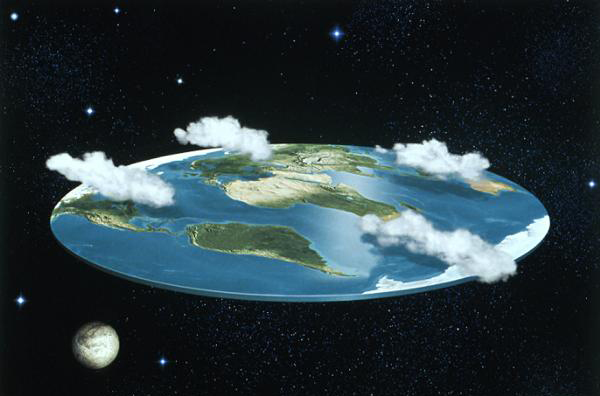
What are they teaching in schools these days?  Certainly not logic. The best one can do if one honestly does not believe in God, is to be neutral on the subject. After all, people at one time could not prove with their eyesight that the Earth was round. They proved it mathematically, but until someone sailed around the globe and took a picture of it from space, there was no proof. In fact, all proof of the roundness of the planet comes to most of us second-hand. We believe the Earth is round because we trust our sources of information. It you want to see what the typical Internet atheist argument looks like, go visit the Flat Earth Society Website, where you will be treated to systems of "logic" which only entertain ideas and concepts that fit within the limitation of their observational and intellectual tools.


Let's face it, "Science" does not have the tools to "see" God, who by all accounts is a pan-dimensional super-intelligent being. If one is a three dimensional being, it would make sense that he would not be equipped to see anything extra-dimensional. The best you could do would be to see where such a being touches our three-dimensional space-time continuum - rather like touching a two-dimensional picture. We'd look like fingerprints to a two-dimensional creature. 

Being a pan-dimensional intelligence, logically God might be capable of almost anything. Any interaction he had with our three-dimensional space would appear to be magic or supernatural (basically above nature). Should He have reason to doubt our capacity for joining the rest of the universe, a God like that might well choose not to reveal too much of Himself or the rest of the cosmos to a people who look like they are planning to blow up their own world and themselves with it someday very soon.  He could be waiting to see if any of us are worth saving and can be trusted out among the stars. That's been bits and pieces of the plots of hundreds of "science" fiction novels and movies since that genre was created. One cannot by any scientific method I know of, prove a thing does not exist without evidence. And there is no evidence of the non-existence of God, only a lot of empty speculation about "Well if God existed he wouldn't allow whatever it is the believer in science believes God shouldn't allow."  I suspect a pan-dimensional intelligence that spans all space and time probably doesn't present Himself to skeptics just because they demand it. Last time He did, they did their best to kill Him permanently by the most heinous method at their disposal (something impossible to do it turns out). To believe that because he cannot see or detect God that God does not exist requires more than a modicum of, dare I say, FAITH.


Now Internet atheists will no doubt resent my comparing them to Flat Earthers, accepting their primary doctrine on faith, or complaining that they claim proof without evidence. After all, that's what Internet atheists call people who believe in God - Flat Earthers and accuse us of being believers in "a magical bearded man who made the Earth". The idea that Christian belief requires a suspension of logic and good sense is a logical fallacy, however.

And for that matter, many logical modern scientists have begun to accept the idea of intelligent design based on recent discoveries in physics, biology, chemistry, and other mainstream hard sciences. It seems of late that ruling out the existent of a pan-dimensional creator/designer is getting harder to do, at least if you're being "scientific" about it. It actually requires far less faith in the unseen to be a Christian than it does in order to be an atheist. 

The atheist must believe that:
  1. His own tiny minority of human beings are right about the whole God thing and that EVERYONE else is completely wrong. 
  2. Hes must believe that 84% of all human beings are completely and utterly wrong about the one biggest thing in human history that most of us believe in. 
  3. He must believe that if there was such a thing as God He is somehow required to present Himself to a gaggle of puny ape-descendants living in a far corner of the galaxy just to satisfy their curiosity about Him. 
  4. He must believe that his inability to prove God exists, somehow proves he doesn't (ignoring the fact that we weren't able to prove germs existed for most of human history right up until we came up with a tool that made that possible). 
  5. He must believe that the universe sprang from nothing while ridiculing the Christian belief that God created the universe from nothing.
  6. He must believe he has the intellect to understand everything in the universe based on hands full of rocks and some telescope pictures, And, if not everything, at least enough to dismiss any pan-dimensional intelligence from consideration.
  7. He must dismiss as a bunch of lying, self-deceived crackpots who are completely and utterly wrong on every point, the 85% of the human race who looks up at the stars and down at the world around them and find traces of the divine.

Christians on the other hand have the luxury of believing that at least 85% of us human beings have at least some piece of the truth about God right. So of all the vast human race, Christians need only believe that 15% of us have it all wrong. I'm betting the 85% are right. The odds favor the existence of God at this stage of things.

And I shall conduct myself accordingly.

Just sayin'.

Tom King

© 2016


Friday, November 20, 2015

The Soon-To-Be Lost Art of the Gentleman's Disagreement


Sometimes best friends are united by their disagreement over politics and religion. Wouldn't it be nice to live in a culture where old friends could sit on the porch and argue politics like gentlemen, share a tall cold glass of sweet tea and enjoy the back and forth of friendly verbal sparring.

One wonders who it is that has convinced us all that anyone who disagrees with us is our enemy. We live in a nation founded on the recognition that each of us is different.

We have fifty states so that you can find one that suits your political, social and economic clothes simply by moving a few hundred miles or so. We put limits on our government and balanced the three branches so that none of them may declare themselves absolute power and that we all might agree to disagree, preserve the right to be who and what we are and continue to live in peace.


The greatest threat to peace and liberty today is the insidious belief that anyone who disagrees with me needs to be shut up. Storm's a comin' folk!

Tom King
© 2015

Monday, July 27, 2015

Love the Sinner


C.S. Lewis once observed that when his Christian teachers used to tell him that he must hate sin while loving the sinner, "I used to think this a silly straw-splitting distinction:  how could you hate what a man did and not hate the man?" This attitude is very common among atheists and unbelievers, as Lewis was when he believed this bit of uncritical thinking. Unrepentant sinners seem to have real difficulty with the Christian claim that we can "Love the sinner and hate the sin." It's one of their greatest points of frustration and the basis of their claim that Christians are all hypocrites because of our obvious hatred of sin.


Critics of Christianity's condemnation of sin, like to point out that such a thing as hating sin without hating the sinner is impossible. One can't hate someone's sins goes the argument, without hating the person who is committing those sins. Therefore, the critics extrapolate from this, that we must accept and embrace sins like homosexual behavior, crude language, drug usage, alcoholism and pornography or we cannot possibly the love sinners who do those things as we claim to do. And if we refuse to, say, sell a gay wedding cake, marry a gay couple, or even attempt to dissuade someone from smoking pot or getting an abortion, then we are, Q.E.D., haters and hypocrites. And if we dare ask someone if he or she would like to come to church, we must be condemning them outright!

The argument unbelievers put forth may feel convincing, but with a very little effort, we can, each and every one of us, find a personal experience of having hated the sin and loved the sinner that disproves their thesis. We need look no further than our own hearts. We've, every one of us, been hating sin and loving a sinner all our lives. The sinner we love most, is, it turns out, ourself! We all commit sins that, in retrospect, we regret having committed. We might not exactly call them sins, but we recognize our less than kindly acts as wrong, whether we give them the name "sins" or not.

We all regret some loss of temper on our part; some bit of cowardice or greed or some lie we have told when the truth might have served us better. When we discover that we have, in fact, committed some unlovely act of which we are ashamed, we are sorry to find that we are the sort of person who could do that. Inevitably, because we love ourselves as much as we do, we forgive ourselves our sin and continue to wish the best for ourselves. In fact, if one does not love one's self, any competent psychologist will tell you that that person is in danger of developing a mental illness, if not a severe psychosis. We are designed to love ourselves. If we do not, our minds inevitably break down, because how can you live as intimately as you do with yourself, if you hate that person.

Jesus, who understood this principle better than any man in history, based his entire distillation of the Law of God upon the fact that every man is born with the innate ability to love himself. When He says, "Love your neighbor as yourself," He tells us not only what we should do, but where to go to find a role model for doing just that. In essence, we already know how to love the sinner and hate the sin from the get-go, for we already know how to love ourselves, as replete with sin as we are.

And, we are born already knowing how to hate the sin without failing in our love for the sinner. "However much I might dislike my own cowardice or conceit or greed," Lewis explains, "I went on loving myself. There had never been the slightest difficulty about it. In fact, the very reason why I hated the things was that I love the man. Just because I loved myself, I was sorry to find that I was the sort of man who did those things."

In the end, Christianity doesn't have to reduce it's hatred for cruelty, greed, murder, lying, adultery or blasphemy by one iota. The truth is, if we love goodness, we ought to hate those sinful acts with a passion, not just for the pain they cause others, but for damage they have done to those we love who are committing those sins. It is at this point that Christians fall to their knees and pray that somehow, in some way, those sinners may be cured of their sin and made whole and human again.

We cannot help it if that makes you unrepentant sinners out there uncomfortable. We're a lot like your mother. We may love you, but if you do bad things, we're probably going to nag you about it and pray for your soul. It may make you feel like we look down on you, but we don't. We just pity you is all. That may make you angry, but if you look at it correctly, if you really do want to do what you want to do, then you can't really get mad at people who don't like it. We don't have to like it. You are free to choose to do what you want to do. So are we. You cannot force us to approve of, what we believe is your misbehavior, anymore than we can force you to behave.

The wonderful and often uncomfortable thing about freedom of choice is that it works both ways. You don't get to disobey on your own hook and then be able to force others to approve of your disobedience. It's hypocrisy at its most blatant to think you can. The old saw, "What's sauce for the goose is sauce for the gander," springs to mind.

Where the strife in this world comes from is when one person or group of persons decides they must control how another group thinks or behaves, especially when that group's behavior does not impinge upon that person or group's right to life, liberty and the pursuit of happiness. And that goes back to the original source of the trouble in the Garden. The whole trouble with sin is that, at it's roots, it stems from a desire to set one's self up in place of God; not the God of love and self-sacrifice, who gives everything of Himself for His creation, but a God of power who is Lord and master over all he surveys.  Such a god is a petty tyrant in the end and all who aspire to this sort of godship inevitably wind up petty tyrants, who seek to enforce their will over others. It should not be surprising when sinners of this sort seek to control how we think and feel and demand that everyone approve of their behavior even when they are sinning in a most public and disgusting manner. Sadly, some of them even call themselves Christians.

Tom King
(c) 2015 

Tuesday, February 10, 2015

May the Force Be Nonsense

Okay, I admit it. I'm looking forward to the new episode of Star Wars coming out next December. I really enjoyed Star Wars – all six episodes and Jar-Jar Binks is one of my very favorite characters. Sure, Episode 7 is being given the Disney magification treatment and they aren't paying much attention to George Lucas with regard to plot, but still………….it's STAR WARS!

I think part of the reason the propeller heads and critics in Hollywood had a problem with the three Star Wars prequels has more to do with the sanctity of Hollywood's religious beliefs than it does with the quality of the movies.  I mean, so far as cinematography and story-telling goes, the Star Wars saga is downright mythological in its presentation from start to finish. Where it gets crosswise of Hollywood in the prequels but did not in the original trilogy, is in the matter of Hollywood's received religious creed. The prequels deviated from the vague magical doctrine of the Force and tried to explain what had heretofore been a comfortably nebulous idea.

In the first three (Episodes 4-6), Luke Skywalker was a devotee of the Force, a "power" described by Obi-Wan Kenobi as, "…"an energy field created by all living things." A perfect description of Hollywood's god. Obi Wan goes on to state that, "It surrounds us, penetrates us, and binds the galaxy together."  Even perfecter*. This jibes with Hollywood's idea of god as an amorphous goodness that springs from all living beings and rewards any trifling bit of goodness that a wealthy, self-absorbed actor, director or producer might muster up. At the same time Hollywood's god doesn't punish the small stuff which really doesn't matter anyway if you're a talented artist. 

In Hollywood Christianity, our souls live forever, being reincarnated as angels or coming back again in new bodies to give it another go at being good enough to become angels. The afterlife is a nebulous spiritual plane from which we can reappear as ghosts until we get our business done and then "go toward the light".  The original Star Wars was close enough to Hollywood's comfy magical religion to warm the cockles of the meanest old Chicago Sun-Times critic's heart.

In the prequel, however, we are introduced to the midi-chloreans, a microscopic life form that helps humans access the force thereby sucking some of the magic out of the thing.  Of course, you have to be born with these midi-chloreans in your blood. That makes you one of a special class of nobilified humans who can kick almost any other human being's butt. This sucked a little more of the magicality out of Star Wars. I suspect the critics, most of whom love magic, didn't appreciate their preconceived idea of the Force as magic and it caused them to turn on Lucas. Lucas was probably confused because he was just trying to tell a story not create a religion.

You'd think the idea of the Force having a dark side might have given some of the high priests of Hollywood pause, but actually, that's probably what endeared the idea of the Force to the Tinsel Town hoi polloi. After all if the God/Force has a dark side, that means it's natural that we do too and therefore it's up to us to decide which side we will choose and exploit. In other words, there is no "God" so to speak, only a mystical force with good and bad wizards sucking off some of that force for their own purposes.How cool would that be, huh?

A friend of mine who was once an actor told me right after Star Wars came out, that the idea of "The Force" was being batted around Hollywood's temples of Eastern Mysticism and séance parlors for years before Star Wars came out.  George Lucas's original vision of a vast impersonal "Force" perfectly fit Hollywood's loosey goosey, wishful-thinking brand of religion. It's little wonder they embraced it. Where Lucas lost them was when he made it a little more real with the midi-chloreans creating themselves a virgin birth child who becomes evil and then has his soul redeemed. 

This introduces the uncomfortable idea that some outside creature or creatures with a will of their own are manipulating things. Worse yet, the prequels make sin a matter of choice rather than simply being the standard good guys are good and bad guys are bad because that's just the way they are - no fault of their own. Can't have goodness without badness.

C.S. Lewis** wrote "If you do not take the distinction between good and bad very seriously, then it is easy to say that anything you find in this world is a part of God."   Whether it's slums, war, homosexuality, or child abuse, one could easily believe that all of it is a part of that sort of god and really not our fault when you reason it all out.

From Hollywood's religious position, good and evil must exist in order to maintain the balance of the universe (and to make good subject matter for highly lucrative movie-making purposes). Hollywood loves the whole Chinese Yin/Yang idea. Evil, according to the Holy Church of Rodeo Drive, is perfectly understandable, since it balances the good in some vague way. It could be said then that Roman Polanski's diddling a 14 year old actress simply opens room in the universe for Sean Penn to do relief work for earthquake victims in Haiti and by the by lets Sean off the hook for cheating on every woman he's ever married.

Hollywood's religion is entirely non-judgmental, fortunately for the Hollywood glitterati whose sins stuff the thousands of pages of fan magazines and gossip columns that fly off the racks in the grocery store aisles ever week.  In Hollywood's religion, there is really no such thing as sin and everyone is accepted as he is, except possibly for Mel Gibson who made that awful Passion of the Christ movie and other blasphemers who violate the ten political correctness guidelines.  A whole range of inconvenient traditional sins can be recast as acts of love and the old morality can be dismissed as bigotry and hate-crime.

Decades before Star Wars premiered, C.S. Lewis wrote in his book The Abolition of Man, "The Life-Force is a sort of tame God. You can switch it on when you want, but it will not bother you. All the thrills of religion and none of the cost. Is the Life-Force the greatest achievement of wishful thinking the world has yet seen?"

Christians think all of this force business is a lot of damned nonsense.  Lewis, in Mere Christianity goes on, "Christianity is a fighting religion. It thinks God made the world – that space and time, heat and cold, and all the colours and tastes, and all the animals and vegetables are things that God 'made up out of His head' as a man makes up a story."

The Christian God is a personal God who exists, not as Pantheists think of him, as some kind of a vaguely conscious force whose bones and sinews are the rocks and mountains, seas and living creatures, stars and nebulae of the universe. The Christian God is emphatically not the universe itself. He is more than that. The Christian idea of God is of a sentient being that actually made the universe for His own purposes and designed it to work in a certain fashion according to immutable laws set down by God, Himself.  We believe that the immutability of those laws is what makes it possible for the very atoms of the things, that make up this universe, to hang together.

Christians also espouse the idea that in this one world where we live, that for whatever purpose, God allowed us to have the free will to choose to do things our own way. When we chose poorly, albeit most deliberately, He then stood back and let things go very badly wrong - something He tried to tell us would happen. Our best guess as to why he let it happen is that, in order to teach us (and presumably the rest of the universe as well), what happens when you embrace sin as a lifestyle choice. He seems to have chosen to let us see that when He said, "The wages of sin is death," He wasn't just being arbitrary. He was trying to tell us one of the biggest secrets of the universe – that if you sin, things inevitably end in death.


We also believe that, as Lewis put it, "God insists, and insists very loudly, on our putting things right again."  He did, after all, provide in the person of His Son, the means by which we might do so.
This is the reason that I believe that when the world goes up in flames and is scoured clean and God returns to us a New Earth renewed, that He is also very likely going to hand us some shovels and rakes and bags of seed that we may have the honor of cleaning up the mess we made and restoring it to its original beauty. I personally think planting trees will be healing to our souls and I look forward to planting some very nice forests and meadows with lots of flowers. Once everything is nicely grown up and looking good, Sheila and I will throw a big party there to celebrate.
You're all invited.


© 2015 by Tom King
 *Yes I know it's "more perfect" not perfecter, but I was going for an effect by deliberately misusing the word. Grammar Nazis just let it go!
** All C.S. Lewis quotes, unless otherwise noted are from "Mere Christianity"

Sunday, April 20, 2014

Betting Your Life


I just removed a militant atheist from my Google circles. It's a relief. Like saying goodbye to a particularly determined Jehovah's Witness. I have no ill will toward atheists, but the constant "I hate religion and I'm smarter than you" rain of hatred gets old quickly.  I think we can all coexist on the whole God/no God issue if we simply respect each other. 

Ultimately, you're betting your life one way or the other. I personally believe in God, but not some of the add-ons that the political church has installed (ever-burning hell, immortal souls, guilt, etc.). Jesus came to relieve guilt, to teach us to forgive, be better people and to prepare us to live forever.  I think it's worth the bet. Certainly my life is better because of my walk with Christ. And I promise I won't burn anyone at the stake, blow up the local farmer's market or call you names because you don't believe the same things I do.

It's a huge universe and we don't know much about it yet and God may actually be the multi-dimensional intelligence that we Christians believe He is. If so, He would not be required to reveal Himself in some kind of fire and thunder display for the amusement of atheists. There might actually be a reason for Him not to do so. If God exists, it's likely He has to be very careful tampering with things here today in order not to have bad things happen farther down the timeline.  I trust a pan-dimensional intelligence has more information than me. As a matter of fact I've seen some pretty amazing things that support my belief that He does exists and knows more than I do.

If I'm wrong, what does it matter to the likes of Christopher Hitchens and Richard Dawkins? Really. Are these guys the summit of human intelligence? Are they clairvoyant that they can look into the universe and see that there is not anything that is beyond their understanding. Religion of the sort that has not been corrupted, looks at the universe and says, "Whoa, that's a lot bigger than I can get my brain around." And we stand in awe of that, knowing we're not such big bugs in the vasty universe after all.

For some reason we are designed to wonder after the infinite - to search for something or some being who exists beyond food-gathering and sex. We look for meaning.

God, while we cannot begin to explain Him, does help us to make sense of it all and human beings so badly want to make sense of it all. Perhaps that's in our design for a reason. I find in that evidence of God. I do not demand that anyone believe or do anything as a result of my belief. Believe. Don't believe.

God, I believe, gave us free will - took a chance that all the trouble that would cause would be worth it in the long run.
It would take a God who lives outside the stream of time to appreciate what sacrifices might need to be made to safely turn loose a creature with free will in the universe. Otherwise you'd get Klingons, the Borg and all manner of evil guys running around from planet to planet murdering and enslaving others just like in the sci-fi novels.

What kind of crappy universe would that be?

Just one man's opinion.

© 2014 by Tom King

Wednesday, November 13, 2013

Atheists Ain't Got No Songs - The Great "Is He real?" Debate

Apparently, Atheists are forming their own churches with all the attendant zeal of a Pentecostal tent revival. They've even come up with some music - a far cry from when Steve Martin and the Steep Canyon Rangers wrote and performed what they called the only song in the Atheist Hymnal - "Atheists Ain't Got No Songs".  I find this an interesting development since I just got off a bloody comment thread/flame war over a column I wrote maintaining that atheism fits the criteria for a religion. My atheist readers took umbrage.

Repeatedly.

I learned some fascinating new ugly names for Christians in the process.  The thing is, I looked up the word.  Religion, it seems, is a system of beliefs about the universe and how it operates. Usually there's some kind of god involved in the system, but not necessarily. A religion is in some part based on faith.

Christians, Jews and Muslims believe in a God, by faith, trusting that God is sitting up there watching us do whatever it is we're doing and doesn't want to reveal Himself openly for reasons of his own.

Atheists believe there is no god, also by faith, trusting that he's NOT sitting up there watching us do whatever it is we're doing and doesn't want to reveal himself for reasons of his own.

Agnostics haven't a clue either way.

The only advantage I can see that atheists have is that they don't have to worry about capitalizing the personal pronoun when talking about him/Him. They certainly feel called to defend their faith when it is attacked, usually with a vehemence reserved by religionists for blasphemers and cartoonists who draw pictures of Mohammed. Most of the Atheists I know are particularly sensitive about what constitutes an attack on their own belief system and respond with unflagging zealotry in defense of their own position on the state of the universe. These guys are also incredibly quick to decry the same level of enthusiasm among religionists defending their own belief system.

Pot and kettle if you ask me.

Just one man's opinion.

© 2013 by Tom King


Saturday, July 27, 2013

Avoid the "My Religion" Trap; Get Outside


I've never understood why "religious" folk, those who take the name of Christ and become 'Christian', fall into the trap of thinking they know more than God about how He should do things.  God says "Forgive," and they say, "But only if they ask with the 'proper' humility."  God says "Love your neighbor as yourself," and they say, "But only if they hold to the correct doctrines."  God says, "The dead know not anything," but they say, "Oh, no, they must suffer by burning in hell forever."  Jesus says, "Don't call your brother a fool," but they say, "What if he is a fool?"

God does not need PR people to maximize attendance in his church. He doesn't need preachers to frighten sinners into being good by telling stories about souls living in torment in Hell that the political church borrowed from the Greeks to use in keeping its members frightened into submission. Why are some who cherish "my religion" so afraid God is going to fall down on the job that they are willing to lie, intimidate and terrorize their fellow man into submission. 

© 2013 by Glenn Sackett
God needs children who will love Him with all their hearts and their neighbors as themselves. He does not ask us to become spiritual stormtroopers. It is a dangerous thing to add extra burdens onto the backs of our fellow men and women that He has not placed on them. When we do so, we make our personal world narrower and narrower and ever more focused on those things we have added to our 'religion' in our misguided efforts to help God out a little where He's gotten slack over the millenia. We come to think of it as "my religion" and when your religion belongs to you, you reduce God to a size you can handle instead of experiencing Him in the utter vastness and splendor that makes you realize that you are really quite a small fellow in a wide world after all. That terrifies some people and they shrink from it, seeking to reduce God to a size they can handle. Once they've done that, then they begin to find fault with the way God does things.  Not big flaws, just minor procedural problems of the sort someone like you could manage quite nicely, so as not to have to bother God about such trivialities anymore. He does have so much to do after all. Why should He be bothered to discipline a few troublesome saints when you are perfectly capable of handling that without having to bother Him at all?

That need to protect God from His own kindness is why so many of us become imprisoned in our own little insular circles.  We do not forgive. We do not leave outcomes in God's hands. If we really look hard at it, we'd find that we don't trust God to be tough enough on others who aren't as "spiritually mature" as we are. And because our reach is not as vast as God's we soon find we can control only that which is within our own very short reach. As a result, over time we imprison ourselves within a tiny space limited by the range within which we feel we can exercise full control over everything in our lives.  Tragically, once we have caged ourselves within that narrow world, we find that there is no room left in there for God. We have shut Him out and are left alone with our self-torment unsuccessfully trying to manage even our own tiny world - a job for which only God is truly suited.

More people should visit the beautiful outdoor places of the world such as the ones in the pictures that accompany this story.  If you spend enough time in such places - the ones built by God - you find that the need to control everything melts away like mud in a hot soapy shower.  When confronted by the majesty of God's creation, it becomes far more and more difficult to hem yourself into the small world of the sort that so many of us "religious" people create for ourselves. When we experience the breath-taking places God has made, we are lifted above our petty selves and as Isaiah said, "will....ride upon the high places of the Earth."  If that's not enough to set your soul free, then you must be enjoying your chains more than I ever did.

© 2010 by Glenn Sackett


© 2013 by Tom King

Wednesday, December 19, 2012

Can an Agnostic Call Himself a Christian?

I read a piece today by a man who says he isn't sure he believes in God, but he likes Christians so much he calls himself one. 

I've been where he is. My walk with God began with a weird prayer,
    The signs are there, though the journey
    getting to them can be downright uncomfortable.
  • "God, I don't know if I even believe you exist, but you make all kinds of sense. So I'm in! I'll read the books, go to church and do all that stuff so I can find out who they say you are, but at some point I'm going to have to meet You in person. You have to show me Yourself. I'm betting my life here that you're real."
And you know what. I've met Him.  Not in the Mosaic, fire-on-the-mountain sense, but over the years, through a whole series of unmistakable signs along the way, He has shown me that He is there and that He is watching my way.

Many Christians are horrified by people like the man above.  How dare he doubt God?  These religious absolutists are so busy being morally certain that they are right that many times, they never quite meet the God they talk so much about and their religion does them little if any good. There's a whole church in Kansas like that. They picket soldiers funerals and taunt gay people. They are so wrapped up in their own righteousness that they've never met the God of the Golden Rule.

I was an agnostic when I found God. I didn't change that much in the days after I was baptised. I was still skeptical. I was anything but morally certain.  But I bought myself a pocket Bible and read it every day walking back and forth to classes at school. 

And I did change. I became a better person and it was none of my doing. I didn't grit my teeth and try to be a good person. I just kept trying to find out who this God person really was and the more I got to know Him, the more it changed me. 

My friend is on the right track though many Christians would find that hard to believe.  There's some evidence that God actually prefers an honest skeptic to a close-minded religious bigot that thinks he can read God's mind.

In the end, it's not membership in the church that will save you. The church is just where you go to hang with people who believe like you do and want to work with you to do the kind of good deeds you will find yourself compelled to do when you spend time with God.  Churches are like God's aid stations where the wounded soul may go to be patched up.  But we don't fight the war on evil in the aid station. We get back out there and do some good.

It's a fascinating journey - trying to find God.  I highly recommend it to anyone looking for what British author Douglas Addams called "The answer to the universal question about life, the universe and everything else."  When you look for God, He will find you and in time, he will even answer the universal question for you. It make take several million years, but he gives you eternal life to boot. 

How cool is that?

Tom

Wednesday, July 25, 2012

What God Hates?


© 2012 by Tom King

Every once in a while, I read an angry post by an offended Christian that lists all the things God supposedly hates – things like agnostics, atheists, gay people and Democrats.  I do sympathize with the person’s desire to tell all the folk in those groups to go straight to hell. They really do say some nasty things to and about Christians, so I suppose it’s natural to want to tell them where to get off.  That is, after all, the point of these kinds of posts whether they actually use the 'H-E–Double Hockey Sticks' word or not.  

The trouble is that, as Christians, we are under orders from Christ, Himself, to treat others the way we want to be treated. What I understand from that is that we may not respond in-kind to nastiness.

I’d like to address one particular point I found in one of these angry missives. The writer said God hates atheists and agnostics.  As a former agnostic myself, I speak with some experience of agnosticism, when I say, “God never hated me.”  On the contrary, I was an agnostic simply because I had not yet met God, so agnosticism was an appropriate belief system for me.  I used to get into it with atheists as often as I did with Christians over the existence of God.  You can’t prove he doesn’t exist I told the atheists.  You can’t prove he does I told the Christians.  And that’s where I drifted until the day I met God for myself.

So, I'd go a little easy on the atheists and agnostics if I were making lists, which I occasionally do. I would argue with my well-meaning friend that God doesn't hate anyone. He gave his son for everyone. He even goes so far as to give us the very impulse to seek Him. That does not come from us. It is hard-wired into our DNA. God also gives us the ability to respond to love and to give love ourselves from the moment we draw breath.  This impulse to love and seek God is at war with our sinful nature - the product of a long history of human abuse of free will. 

In my own experience when I was an agnostic, I was searching high and low for God. And it wasn''t God blocking my path to Him.  It was well-meaning churchmen and women who thought they were doing God a favor by portraying him as an angry, judgmental, send-em-off-to-hellfire deity who would cast you into hell and torture you forever if you habitually skip Sunday School.They had fallen prey to the temptation to use fear to rally the troops. As an experienced troop rallyer, I can tell you that fear is a poor motivational tool.  When God sends an angel to help, the first thing the angel always says is "Fear not."  I assume from that that God doesn't use fear to frighten people into submission.  And, by "fear", I don't mean respect or awe. I mean the afraid for your life kind of fear.

When I finally met God himself, I cast aside my agnosticism quite easily, because it no longer served me. I had finally met the Father I was looking for and that made all the different. A list of all the things God "hates" probably isn't going to save a single soul. A list of the things God loves might be a more effective tool. For instance, how about this list?

  1. God loves a cheerful giver.
  2. God loves one who would give his life for another.
  3. God loves a kind word and a cheerful heart.
  4. God loves a patient man.
  5. God loves the world so much he sent his own Son to save us.
  6. God loves us so much he wants us to live forever.
  7. God loves beauty and truth.
  8. God loves unconditionally. He loves us even when we reject him.
  9. God makes everything come out for the best if we'll let him.
  10. God loves us so much he wants to give us the wealth of the whole vast universe.

In the end, I believe we should always be kind to others if we must make lists. You never know who is a tender heart, all wrapped up in a protective coat of agnosticism or atheism, but who is really, down deep, just searching desperately for the real God – the loving Father no one has ever introduced him to.


Saturday, August 20, 2011

Information Nazis and the Great Controversy

by Tom King (c) 2011

One gains spiritual insight from places that may at first glance seem odd. “Information Weekly”, a journal for CIOs and data management people ran an editorial this week in their global-CIO segment called “The CIO vs. The Information Access Mafia” that I found enlightening.

Howard Anderson interviews Stu Laura, a Wall Street corporate Chief Information Officer (CIO) about his frustrations with his company's internal information wars. Laura's problem is that his company's staff is fighting a turf war over who has access to what information.

On the one hand, the company's product development people need broad access to information in order to get the “bonus” of coming up with creative ideas that cross boundaries. On the other hand, the data management people - Laura calls them “Information Nazis” - are concerned (to the level of paranoia sometimes) that the wrong people in the company may have access to sensitive data. As a result, the company's system of approving who has access to what data is so slow that, according to Laura, they “squash great ideas”.

This problem finds its parallel in government where big government/high control types want decision-making about who has access to information about services offered by or input into the governing process placed in the hands of a few insiders. This “nanny state” approach prevents the children from hurting themselves by keeping them away from things considered “dangerous” by those who know better.

Facing off against the progressive/socialists are small government/low control advocates who want a less restrictive environment, more freedom, and less regulation with strict punishment for those who abuse the privilege.

Laura's solution, ironically for a data management guy, steps outside the “computer problem” box and recognizes that the problem is a business management problem. He says, “The only thing that might work is if we let people escalate and then come down very hard on those who abuse the privilege.” In effect, he advocates less control on the top end and firm punishment for violating the trust shown people. This parallels the small government/lower regulation philosophy in the political arena.

At the same time there is a spiritual lesson to be drawn from the information wars. This high control vs. low control argument has gone on for a long time in the Judeo-Christian faith. Jesus, Himself, preached a brand of religion that freed people from the access-to-God Nazis in the Sanhedrin. It's why they felt they had to murder Him. All this freedom imperiled their control over the populace and the Scribes, Pharisees and Saducees could imagine all sorts of bad things happening to the poor people they felt charged with “protecting”.

The pattern was repeated in the Dark Ages and Medieval era when the Roman Catholic church restricted access to Scripture to clergy alone, on the grounds that “the people” needed protecting lest they misinterpret what Scripture said, especially on those issues that differed with official church doctrine or practice. Turns out they were right to fear open access by the people to God's Word for as soon as the Bible began to be printed in the common tongue, the Protestant Reformation swept the Christian world and the power of church authorities was diminished.

Again, after all that heady wave of religious freedom, many Protestant church heirarchies began to look for ways to hem in their congregations or to place church leadership between the people and the ultimate source of information, if you will. Having people reporting directly to God is always problematic for church bureaucrats because it limits their power and exposes them to severe consequences if they get caught exercising the “privileges of power” enjoyed by so many generations of powerful men and women in ages past.

All these conflicts are basically a single conflict. It was once called “The Great Controversy” by a 19th century religious writer in a book by that name. The controversy dates back to the beginning of creation when God decided to make man with the power of free will. This level of free will had, apparently, not been granted to any other creature in the history of the universe. Only one “prototype” creature with that in-built freedom of choice existed – the angelic choirmaster, Lucifer.

When God developed plans to create Man, he saw that it would be inevitable that any creature with total free will would, like Laura's creative staffers, abuse the privilege. To insure that His new creation would not self-destruct, God developed a plan that involved incredible sacrifice on His part. He willingly sacrificed Himself in the form of his Son because, evidently, God thought it was important that a creature like Man should exist in the universe.

Lucifer, knowing well the temptation to sin that comes with free will, seems to have decided that a more restrictive approach was in order. He probably guessed what sort of mischief men and women could get up to and decided it would be better to place restrictions on them in the first place to save them from themselves. Lucifer, the original “Information Nazi” apparently carried his disagreement over the nature of Man to the point of creating a “revolution” among the angels in support of his view. God finally had to kick him and his followers out of heaven to restore order.

Lucifer carried his war to the Earth, conducting a guerrila campaign to prove to God just how wrong God was. You can look down the history of this planet and see, time and again, governments set up following a restrictive, elite-governed model that purports to “protect” the people. In the end, these governments by the nobles, the commisars, the emperors and the upper classes inevitably abuse the very people they are sworn to protect.

God's model is basically a high freedom (we may sin if we choose), high access (we have a direct line to God) and strict punishment (loss of life for abusing the privileges) model. Myself, I believe that this dangerous model is essential if God is going to people the universe with creatures like himself in their ability to choose. I don't believe humans could create as prolifically as we do were our free will more restricted. It is that creativity that, I believe, is the “image” of God described in Genesis.

Television, radio, literature, art, movies andYoutube would not be nearly as interesting if we had all been made like Lucifer thought we should and all lived under Lucifer's idea of “good government”. God wanted sons and daughters, not “the workers” and “the masses”. I think God wanted children who are individuals, not cookie-cutter “congregations”. Can you explain all the varied denominations of Christianity any other way than as expressions of worship by individuals with different tastes, cultures and understandings of God's Word? Sure we have our differences, but each of us carries a piece of the truth and each of us is striving to reach the same place. One day, when at last we all come together on the Sea of Glass, I expect we will make one whale of a choir, each one of millions upon millions of unique people, bringing his or her own experience to the song to create a harmony like nothing we've ever experienced.

God wants us to be free and unique individuals. The everything-fair-and-the-same-for-all” approach simply doesn't produce human beings of sufficiently good quality that it would be safe for God to grant eternal life to them. Such people will be inconstant and indecisive, wandering from powerful leader to powerful leader, whichever catches their attention – a useful trait in people if you are one of the politburo or a member of the nobility or church heirarchy and wish to keep the troops in line (behind yourself, of course). Such people find it difficult to look beyond mortal leaders to communicate with God directly. Like the Children of Israel, they are slaves and beg for some powerful leader to stand between them and God. And once the leader goes up into the mountain, they choose another one, or carve one out of gold to tide them over. They have not the stuff to stand for the right alone, but must have the permission of the heard to make any decision. Such people sacrifice their true self for a delusion of safety in numbers.

Like I said, God wants sons and daughters, not slaves and concubines. In that respect, we are also like Him for do we not want sons and daughters, not butlers and maids? Isn't it difficult for us to see our kids suffer and learn hard lessons for themselves. Aren't we proud, though, when they do learn, grow and mature into amazing people? Do we not experience great joy in their triumphs and achievements?

And would we not die for them as well?

So when someone asks you “How could God let all these bad things happen?” recognize where this idea that people need to be protected from bad things comes from. It's not from heaven.

Me, I welcome the pain and trials of this life, because I believe that heaven is cheap enough at that price. When we seek to protect ourselves and others from all pain or the consequences of our own actions, we choose a path that leads downward to tyranny, stagnation and a bland and wasted life.

Albert Einstein once wondered why we couldn't figure out a way to make everyone happy. Einstein, brilliant though he was, thought of it as a “computer problem”. If we could figure out how people work, we should be able to program our world so that everyone would be content and cared for. But, life is not a computer problem. It's a self-management problem. You don't run a happy planet by knowing which buttons to push or how to design effective systems of government. You run a happy planet by filling it with good, happy people that have no interest in lording over their fellow men and women. You change the individuals, not the system. 

If you just like the computer analogy, think of it this way. If we allow God to clean up the corrupt coding in our software through our relationship with Him, He in turn gives us back ourselves free from the viruses, trojan horses and malware that once infected us. But cleaning us up alone does not solve the problem of how to make people happy or how to make a clean and ordered world. We have to choose for ourselves how to do that. Then we must roll up our sleeves and do our job. It's the job God gave us in the first place – to tend the Earth.

I don't know about you, but I'm looking forward to getting to work in the garden.

Tom

Sunday, May 01, 2011

On Sheep and Wolves

(c) public domain
http://wpclipart.com/

 Is it necessary to become wolves
in order for sheep to defend
themselves from predators?

My friend, Duane, sent me this interesting quotation.

"A society of sheep must
in time beget a
government of wolves
and it is useless for the
sheep to pass resolutions
in favour of vegetarianism
whilst the wolf remains
of a different opinion."

Dean William R. Inge

While a probable truism for the world as it is, assuming man is on his own in the vasty universe, there is one factor that will, prevent this principle from playing out as an inevitability. Yes, it is likely true that the wolves will inevitably dominate if they are the top of the food chain in a world controlled by evolutionary forces alone, but.....

We humble sheep do, after all, have a Shepherd to protect us from the wolves!

It's a flaw in Christians that we carry with us from the old life of sin that we have this sneaking suspicion that God's intervention on our behalf is somehow inadequate and that He somehow needs our help if the flock is to be maintained properly.  We somehow carry with us this nagging need to "help out the shepherd" even though He has made it quite clear that our safety and our eventual salvation is something we cannot accomplish by our own merits or efforts. The Shepherd cautions us that our own hard work will not save us. Our future depends on our faith in Him.  He says be wise as serpents, but gentle as doves. At no time are we instructed, however, to become like serpents, or wolves for that matter in order to help save ourselves.

What about when wolves seek to destroy us as they have so often in the past? My study of history shows that governments may come and governments may go, but the faithful remain. There is a reason that when God does send angels to intervene for us, the first thing they always say is "Fear not!"

In these trying times, I would counsel all my brothers and sisters in the faith to fear not. Study, pray and do the work God puts before you. Let the Shepherd protect the flock. It would not be a good idea to become wolves simply because we are afraid of them. We have a far greater protector; one stronger than any enemy the wolves can send against us.

Tom King - Tyler, TX